

Persistent or painful verrucas are more common than many people realise – and living with one that refuses to clear up, or not knowing whether it is healing or simply staying the same, can be genuinely frustrating. We understand that examining a verruca over weeks or months without knowing what to look for adds unnecessary uncertainty to an already uncomfortable situation.
Here at Waverley Clinic in the heart of Farnham, our HCPC-registered podiatrists see verrucas in patients of all ages every week. The questions we hear most often are: what stage is my verruca at, and is it actually getting better? This guide answers both – and explains clearly when professional treatment is the right next step.
What Does a Verruca Look Like When It First Appears?
In its earliest stage, a verruca typically appears as a small, pale or skin-coloured patch on the sole of the foot – often no larger than a few millimetres. The surface feels rougher than the surrounding skin, and on close inspection you may notice tiny black or brown dots within the lesion. These dots are small capillary blood vessels that have grown into the wart tissue, and they are one of the most reliable ways to distinguish a verruca from a corn or callus.
Unlike a corn, which compresses the natural skin lines of the foot, a verruca disrupts them. The ridges of your skin will travel around the verruca rather than through it – a subtle but important distinction that is worth examining closely if you are uncertain about what you have.
Verruca Stages – From Early to Established
Early Stage – Small, Flat, and Easily Missed
Early verrucas are often small enough to be dismissed as a patch of hard skin or a minor callus. They may be slightly raised or sit flush with the skin surface, and the black capillary dots may not yet be clearly visible. At this stage, over-the-counter salicylic acid treatments are most likely to be effective, provided they are applied consistently every day over several weeks.
Growing / Established – Larger, Deeper, and More Defined
As a verruca develops, it typically grows in both diameter and depth. The black dots become more prominent, the surface grows rougher and more keratinised, and it may begin to cause discomfort – particularly when walking or standing, as pressure forces the lesion inward against the soft tissue beneath. At this stage, home treatments become considerably less reliable, and a podiatrist is well placed to offer more targeted and effective options.
Mosaic Verruca – A Cluster of Multiple Lesions
Some verrucas develop as a cluster of smaller, closely grouped lesions known as a mosaic verruca. These cover a wider area of the sole and are often more resistant to treatment than a single isolated lesion. If you have a mosaic verruca that is not responding to over-the-counter treatment, a professional assessment is the most effective next step.
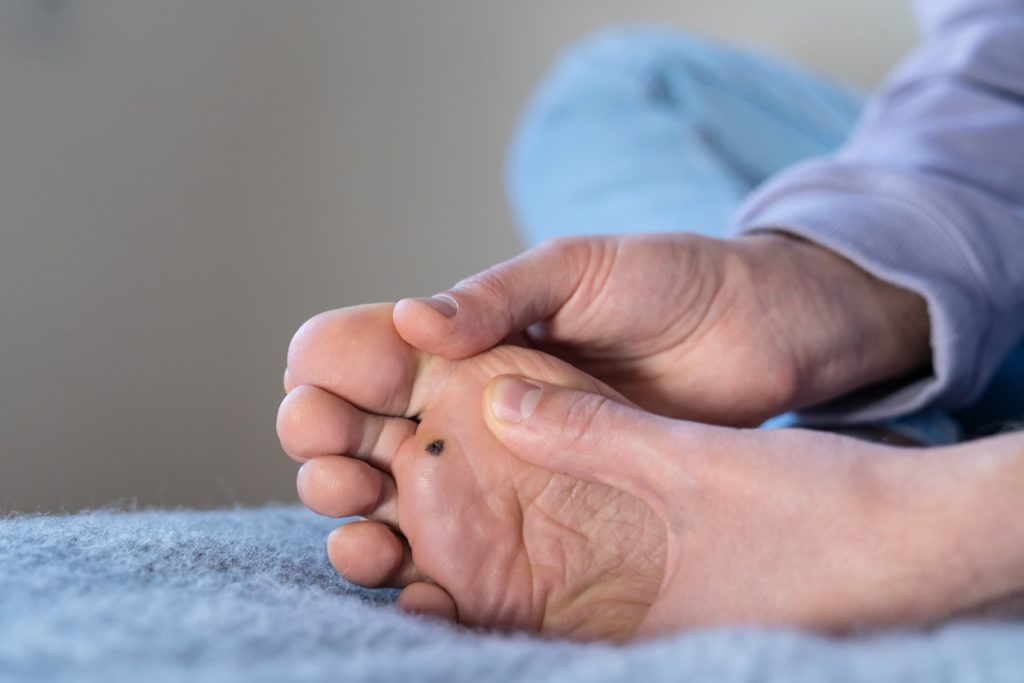
What Does a Dying Verruca Look Like?
This is the question most patients with a persistent verruca eventually ask – and it is a reassuring one, because it usually means something is visibly changing. A verruca that is beginning to resolve shows several recognisable signs.
The surface may become darker or turn black as the blood supply to the wart tissue is disrupted. The black capillary dots you noticed earlier may multiply or become more pronounced before disappearing altogether – this darkening is a positive sign, not a cause for concern. The verruca may feel different underfoot, sometimes becoming more tender before it improves, and the overall size typically begins to reduce inward rather than spreading outward.
In some cases, the centre of the verruca appears to hollow out slightly, leaving a small pit or indentation. This can appear alarming but is a completely normal part of the healing process: it indicates that the wart tissue is breaking down and the healthy skin beneath is beginning to recover.
What to look for: darkening colour, shrinking size, multiplying then disappearing black dots, and reduced pain on pressure. These are all signs a verruca is resolving – not worsening.
What Is the Hole in a Verruca?
The small hole or pit that sometimes appears in a healing verruca is one of the most commonly misunderstood signs. It is not a wound, and it is not a sign of infection. It is what remains when the wart tissue dies and separates from the healthy skin around it, leaving a shallow crater in the surface of the foot.
This occurs most commonly after cryotherapy (freezing treatment) or when a verruca resolves naturally after a prolonged period. The crater will gradually fill in as healthy skin regenerates underneath – usually within a few weeks. If it remains open for an extended period, feels sore beyond expected tenderness, or shows signs of infection such as spreading redness, warmth, or any discharge, we would recommend seeking advice from a podiatrist.
How Long Does a Verruca Take to Go Away?
Recovery time varies considerably, and there is no single universal timeline. In children, verrucas frequently resolve on their own within one to two years as the immune system mounts a response to the HPV virus. In adults, this immune response is less consistent, and verrucas can persist for several years without active treatment, particularly in those who are immunocompromised or managing ongoing health conditions.
Over-the-counter salicylic acid treatments typically recommend a course of eight to twelve weeks of daily application. Professional treatments such as cryotherapy or laser therapy are designed to accelerate recovery, though the number of sessions required depends on the size, depth, and duration of the lesion. A podiatrist can provide a realistic and personalised timeframe following a first assessment.
Verruca or Corn – How to Tell the Difference
Because both present as patches of hardened or roughened skin on the foot, verrucas and corns are frequently confused. The table below outlines the key distinguishing features:
| Feature | Verruca | Corn |
|---|---|---|
| Black dots | Present – capillary vessels clearly visible | Absent |
| Skin lines | Disrupted – ridges travel around it | Intact – ridges run through it |
| Pain type | Squeezed from the sides – more painful | Direct pressure – more painful |
| Appearance | Rough, cauliflower-like surface | Smooth, hard central core |
| Location | Anywhere on sole or toes | Over bony pressure points |
If you remain uncertain after comparing both, a podiatrist can confirm the diagnosis at a first appointment – it is a straightforward visual assessment that takes only a few minutes.
For more information, please read ‘Our guide to preventing and treating verrucas’.
When Should You See a Podiatrist About a Verruca?
Most verrucas do not require urgent treatment, and a straightforward early-stage lesion is entirely reasonable to manage at home in the first instance. However, there are clear signals that professional assessment is the most appropriate next step.
We would recommend booking an appointment if your verruca has been present for more than two years without showing signs of improvement; if it is causing pain that is affecting the way you walk; if it has grown significantly in size or is spreading to neighbouring areas; or if you are managing diabetes or reduced circulation in your feet, in which case even a mild lesion warrants early professional attention. And if you are unsure whether what you have is a verruca at all, a podiatrist can confirm the diagnosis promptly and save you weeks of treating the wrong condition.
Concerned about your child’s verruca? Read our dedicated guide ‘Why Won’t My Child’s Verruca Go Away?’
Verruca Treatment at Waverley Clinic, Farnham
At Waverley Clinic in the heart of Farnham, our HCPC-registered podiatrists treat verrucas in adults and children across Surrey. Whether you need a diagnosis, advice on the most appropriate treatment, or a more active intervention for a long-standing or painful lesion, our experienced team is here to help.
Take the first step towards clear, effective treatment by booking a verruca assessment with us today – and allow our team to help you move forward with complete confidence.
Ready to book your appointment at Waverley Clinic? You can do so quickly and conveniently online, or by giving us a call at 01252 716611. Our telephone booking service is available 24 hours a day, seven days a week.
For comprehensive information on verruca treatment, please visit our dedicated ‘Verruca Foot’ information page.
