


Welcome to Waverley Clinic, your trusted centre for specialist podiatry located in the heart of Farnham. The Achilles tendon is used during every single step, jump, and stride you take. When this crucial structure becomes compromised, the resulting stiffness and sharp discomfort can completely halt your active lifestyle. If you are experiencing persistent soreness at the back of your ankle or struggling to push off the ground without wincing, you do not have to endure this restriction indefinitely.
Our dedicated clinical team is committed to helping you regain your strength and mobility. At our modern, purpose-built facility, we provide highly effective Achilles tendinopathy treatment tailored to your specific biomechanical needs. Take the first step towards a full recovery and restore your physical confidence with our professional, patient-focused care.


Understanding Achilles Tendinopathy and Tendon Mechanics
To effectively address your discomfort, it is important to understand the unique anatomy of your lower leg. The Achilles tendon is the longest and strongest tendon in the human body. It serves a vital mechanical function by connecting your powerful calf muscles directly to your heel bone (calcaneus). Interestingly, unlike most tendons in the body, the Achilles does not possess a true tendon sheath. Instead, it is surrounded by a vascularised layer of tissue known as the paratenon.
Despite its immense strength, the tendon has a specific structural vulnerability. There is an avascular region located approximately two to six centimetres above where the tendon attaches to the heel. Because this specific area has a naturally limited blood supply, it struggles to repair itself efficiently following microscopic tissue damage. When the tendon is subjected to repetitive mechanical strain or sudden overload, degenerative changes occur within the tissue fibres, leading to the painful clinical condition known as Achilles tendinopathy.
Biomechanical Imbalances:
Structural anomalies, such as leg length discrepancies or overpronation (where the foot rolls inward excessively), place abnormal twisting forces on the Achilles tendon during movement.
Muscular Weakness and Tightness:
Weak or chronically tight calf muscles force the Achilles tendon to absorb a much higher percentage of impact shock, accelerating tissue fatigue.
Restricted Joint Mobility:
Stiffness in the ankle joints or hips alters your natural gait, forcing compensatory movements that overload the lower leg.
Training Errors:
Pushing your body too hard, too soon is a leading cause of tendon injury. Rapidly increasing your running mileage or introducing intensive hill training without adequate rest overburdens the tissue before it has time to adapt and strengthen.

Professional Clinical Diagnosis at Waverley Clinic
Attempting to ignore tendon pain or relying on generic advice can lead to severe structural deterioration, increasing the risk of a complete tendon rupture. Securing a professional clinical assessment is the safest way to protect your long-term mobility.
When you visit our Farnham clinic, our highly skilled clinicians conduct a meticulous physical examination. We thoroughly assess your lower limb biomechanics, evaluating your joint range of motion, muscular strength, and overall flexibility. GaitScan technology may be used to confirm foot function and posture leading to increased Achilles tendon load and pressure.
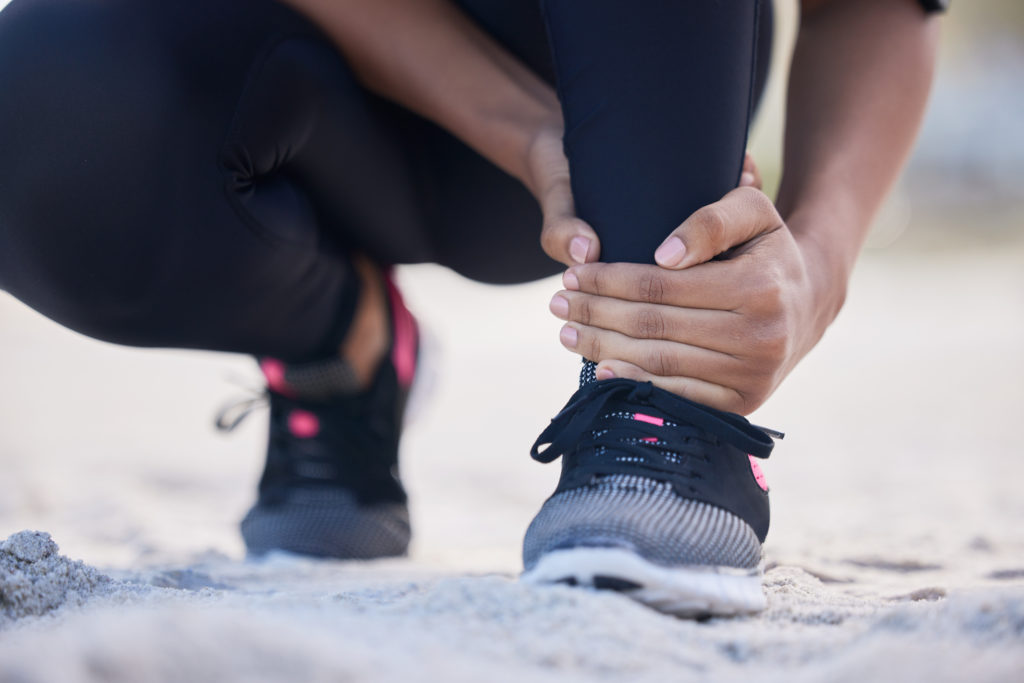
Our experience enables us to recommend the most effective approach according to your unique clinical presentation. We formulate bespoke recovery programmes that target both your immediate symptoms and the underlying mechanical causes of your injury.
Corrective Biomechanical Support
If our comprehensive assessment reveals that foot posture is contributing to your tendon overload, we may recommend bespoke orthotic insoles. By utilising advanced digital GaitScan technology, we can design custom prescription orthotics that gently correct overpronation and stabilise your heel. This drastically reduces the abnormal rotational forces acting on your Achilles tendon, creating an optimal mechanical environment for tissue healing.
K-Laser Therapy
For persistent Achilles tendon pain, we offer K-Laser therapy, an advanced, non-invasive laser treatment. Specific wavelengths of light penetrate deep into the injured tendon, stimulating the body’s natural cellular repair processes, improving local blood flow, and helping to reduce pain and inflammation.
Treatment is painless, with most patients describing a gentle, soothing warmth on the skin. Sessions are quick, and a short course of treatment is typically recommended to achieve the best results. Your podiatrist will advise on the number of sessions suited to your condition, alongside guidance on managing your activity between treatments to give the tendon the best opportunity to heal.
Revolutionary Shockwave Therapy (ESWT)
For patients suffering from chronic, recalcitrant Achilles tendinopathy that has not responded to standard conservative exercises, we offer highly advanced Extracorporeal Shock Wave Therapy (ESWT).
Our clinic has invested in state-of-the-art shockwave technology to provide a proven, non-invasive solution for stubborn tendon pain. During this treatment, high-energy acoustic sound waves are directed precisely at the injured area of the tendon. These mechanical waves penetrate the tissue, stimulating a profound biological response.


The application of shockwave therapy achieves two critical clinical goals. Firstly, it temporarily overstimulates the local nerve endings, which provides a significant and immediate reduction in chronic pain. Secondly, it triggers a process called neovascularisation—the formation of new, microscopic blood vessels.
By dramatically increasing blood flow to the notoriously poorly vascularised region of the Achilles tendon, shockwave therapy actively jump-starts your body’s natural cellular repair mechanisms. It effectively clears away chronic inflammation and encourages the regeneration of healthy, resilient tendon fibres.
What to Expect From Your Shockwave Sessions
Shockwave therapy is incredibly safe, requires minimal downtime, and boasts a high clinical success rate. For optimal results, a structured treatment protocol is essential. Most patients achieve significant, lasting relief after a course of three to five brief sessions, typically spaced at weekly intervals.
Our experts carefully monitor your progress, adjusting the intensity of the treatment to ensure your complete comfort while maximising the therapeutic benefit. When combined with your targeted eccentric loading programme, shockwave therapy provides an unparalleled pathway back to full, pain-free mobility.
Persistent tendon problems do not have to dictate your physical capabilities or limit your athletic ambitions. The dedicated team at Waverley Clinic is here to provide the highest standard of professional care, empowering you to overcome the frustration of chronic Achilles heel pain. We combine extensive diagnostic expertise with a reassuring, supportive environment, ensuring you feel confident and informed at every stage of your rehabilitation journey.
We are proud to serve the Farnham community, offering advanced treatments and long-term mechanical solutions for all your lower limb needs. Enhance your performance and take control of your physical health today.
Alternatively, speak directly with our friendly reception team – available 24/7 – to discuss your needs and schedule your visit – Tel: 01252 716611
Achilles tendinopathy is a painful condition affecting the large tendon that connects your calf muscles to your heel bone. It typically develops from repetitive mechanical overload, such as a sudden increase in walking or running distances, or wearing unsupportive footwear. This continuous physical stress causes microscopic tissue damage and cellular inflammation within the tendon, leading to persistent discomfort that can severely limit your activity.
The most frequent biological warning signals include a gradual onset of pain, noticeable swelling, and stiffness at the back of your heel or lower leg. You will often feel this stiffness most acutely first thing in the morning or after periods of rest. If you experience these symptoms, we strongly encourage you to take the first step towards recovery before the condition actively restricts your daily independence.
You should consult our expert clinicians as soon as you experience persistent discomfort that does not improve with a few days of rest, or if the pain forces you to alter your natural walking stride. Ignoring early pain can quickly turn a highly treatable issue into a complex, chronic problem. At our modern facility in the heart of Farnham, our dedicated team is ready to provide the supportive care you need to restore your comfortable mobility.
When you visit Waverley Clinic, you can expect a meticulous physical evaluation delivered in a reassuring, patient-focused environment. We begin by discussing your daily activity levels, specific physical goals, and the exact nature of your discomfort. Using advanced clinical techniques, our expert podiatrists thoroughly analyse your joint mobility and unique biomechanics to identify the precise structural faults placing excessive strain on your healing tendon.
Our clinical team provides a comprehensive range of evidence-based treatments tailored precisely to your unique structural needs. Depending on your specific clinical diagnosis, your bespoke treatment plan may include:
Proactive management is the absolute foundation of long-term physical resilience. By identifying subtle muscle imbalances and mechanical inefficiencies during your visit, we empower you to protect your long-term joint health. We will equip you with tailored strengthening exercises, precise footwear advice, and practical strategies to safely manage your physical load. This supportive approach actively enhances your structural stability, allowing you to move forward safely and with complete confidence.
Bespoke mechanical support to actively relieve pressure, correct structural overload, and support your physical foundation.
Absolutely NOT. Painful Achilles tendon indicates damage, high pressure and strain, which may tear. This is an extremely traumatic and painful event that often requires surgical repair, along with a long recovery and rehabilitation period.

Your privacy settings
Manage Consent Preferences
Necessary
Analytics
Embedded Videos
Google Fonts
Marketing
Facebook Advanced Matching
Facebook CAPI